Florida Flood Insurance and Hurricane Storm Surge: What Your Homeowners Policy Won't Pay For in 2026
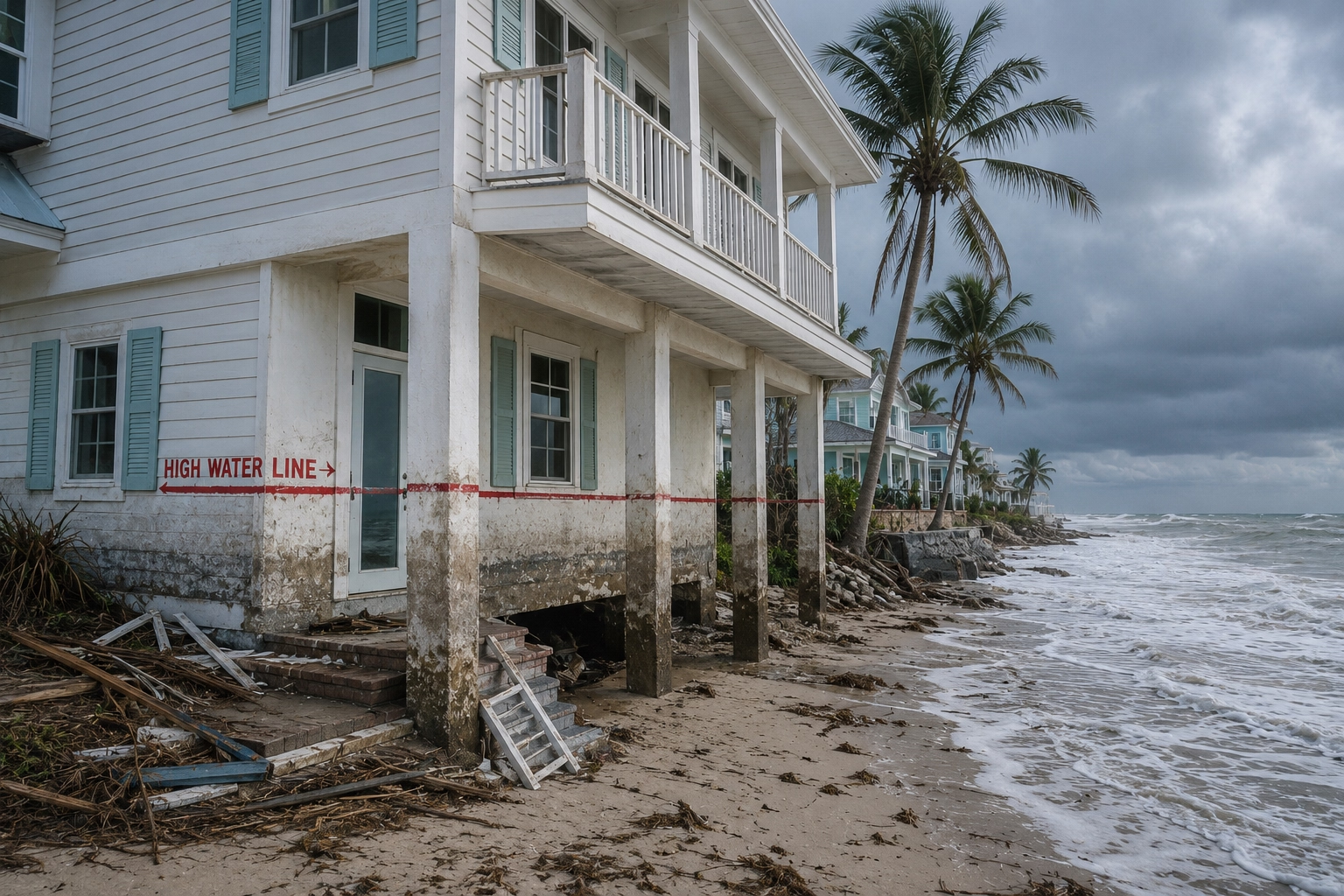

Hurricane season starts June 1, and the most expensive mistake Florida homeowners make is assuming their homeowners policy covers a hurricane. It doesn't, at least not all of it. The single largest source of uninsured loss after a Florida hurricane isn't wind, roof damage, or tree falls. It's storm surge. And storm surge is flood damage, which standard homeowners insurance explicitly excludes.
This guide explains exactly how the wind versus flood split works in Florida, what your National Flood Insurance Program (NFIP) policy actually covers during a hurricane, the deductible math most homeowners get wrong, and what to do if you have to file claims on two policies at once.
Quick answer
Florida homeowners insurance covers hurricane wind damage such as roof, windows, and wind-driven rain through openings. It does not cover hurricane storm surge or flooding from rising water. Storm surge claims require a separate flood insurance policy through the NFIP or a private flood carrier. After Hurricanes Ian, Helene, and Milton, the average NFIP claim payment in Florida exceeded $80,000, and roughly 29% of claims came from properties outside designated high-risk flood zones. If a hurricane causes both wind and water damage, you'll file two claims with two adjusters, and how the damage is documented determines which policy pays for what.
Why this matters now
Florida has been hit by four major hurricanes since 2021: Ian (2022), Idalia (2023), Helene (2024), and Milton (2024). Two patterns repeated after every one. Homeowners with only a wind policy received partial settlements that didn't cover the bulk of their damage. Homeowners with both wind and flood coverage received roughly twice the total payout, but only when the wind versus flood split was documented correctly from day one.
NBC News profiled Sanibel Island homeowner Susan Cavanaugh after Hurricane Ian. Her first-floor storm surge damage was uninsured because she carried homeowners insurance only. Her experience wasn't unusual. FEMA later reported that the majority of Ian's flood damage in Florida was sustained by homeowners without flood policies.
This year's outlook from NOAA and Colorado State University points to another above-average Atlantic season. If you don't have flood insurance and a storm forms, you're out of options. NFIP and private flood policies both freeze new coverage once a named storm has formed, and NFIP imposes a 30-day waiting period from purchase to coverage start. Buying flood insurance the week of a hurricane warning is too late.
The wind versus flood split, explained
Florida insurance treats hurricane wind and hurricane water as two completely different perils, governed by two completely different policies, with two completely different deductibles. Understanding this split is the difference between a covered loss and a $100,000 out-of-pocket disaster.
What your Florida homeowners policy covers during a hurricane
A standard HO-3 or HO-5 Florida homeowners policy covers wind-related hurricane damage. This includes roof damage from wind (missing shingles, tiles, and structural roof loss), broken windows, doors, and exterior wall damage from wind or wind-borne debris, wind-driven rain that enters the home through an opening created by wind (a broken window, a hole in the roof, a torn-off soffit), tree damage caused by wind (with limits on tree removal costs), and detached structures damaged by wind such as fences, sheds, and screen enclosures.
This coverage is subject to your hurricane deductible, a percentage-based deductible (typically 2%, 5%, or 10% of your dwelling Coverage A limit) that applies during named storms in Florida, per Florida Statute 627.701.
What your Florida homeowners policy does NOT cover during a hurricane
Your standard homeowners policy explicitly excludes flood damage. This includes storm surge (coastal flooding caused by hurricane winds pushing ocean water inland), rising water from rivers, canals, lakes, or stormwater drainage, surface water runoff from heavy rain that doesn't drain properly, mudflow, sewer or drain backup caused by flooding (a separate optional homeowners endorsement may apply), and any water damage that originates from below the structure.
This is the gap that destroyed Susan Cavanaugh's finances after Ian, and the gap that the Florida Realtors association now warns homeowners about every May before hurricane season begins.
What your flood insurance policy covers during a hurricane
A flood policy through the NFIP or a private carrier covers all of the water-from-below damage your homeowners policy excludes. This includes storm surge (regardless of how far inland it travels), rising water from canals, drainage, and surface runoff, damage to building structure, foundation, electrical, plumbing, HVAC, and built-in appliances (NFIP Building Property coverage, up to $250,000), damage to personal contents such as furniture, electronics, and clothing (NFIP Contents coverage, optional, up to $100,000), and debris removal plus ICC (Increased Cost of Compliance) for required rebuilding to code, up to $30,000.
NFIP flood insurance does not cover Additional Living Expenses if your home is uninhabitable. Most private flood policies do, which is one of several reasons private flood has captured a growing share of the Florida market.
How NFIP deductibles work during a hurricane
This is where most Florida homeowners save or lose the most money. NFIP flood deductibles operate completely independently from your homeowners hurricane deductible.
Hurricane deductible vs. flood deductible: a real-world example
Here's an actual claim scenario from a Tallahassee homeowner after Hurricane Helene, documented by the Merlin Law Group.
The homeowner's insured dwelling value was $240,000. Their hurricane deductible on the homeowners policy was 5%, or $12,000. Their NFIP flood deductible was $2,500. Total damage assessed came to $85,000.
In the initial claim attempt, the homeowner filed everything under the homeowners policy. The carrier applied the $12,000 hurricane deductible against the full $85,000, leaving $73,000 in payable wind damage. But $40,000 of that wasn't actually wind damage. It was storm-surge flooding the homeowners policy excluded. The carrier denied that portion. The net payout was $33,000.
In the corrected claim, after a public adjuster split the damage, $45,000 was attributed to wind under the homeowners policy. With the $12,000 hurricane deductible, that paid out $33,000. The remaining $40,000 was attributed to flood under the NFIP policy. With the $2,500 flood deductible, that paid out $37,500. The total payout came to $70,500, a $37,500 increase over the original claim.
The lesson: even when the total dollar damage is the same, splitting it across the right policies dramatically reduces the deductible burden. Two smaller deductibles almost always cost less than one large hurricane deductible.
What gets covered where: a quick reference
Damage covered by your homeowners policy (wind):
- Roof torn off by wind
- Rain entering through wind-damaged roof
- Broken windows from wind-borne debris
- Fence and screen enclosure damage from wind
- Furniture ruined by rain through broken window
- Additional Living Expenses (hotel, meals)
Damage covered by your flood policy (NFIP or private):
- Storm surge flooding the first floor
- Rising water from drainage canal
- Foundation damage from surge
- Detached garage flooded by surge (NFIP covers up to 10% of building limit)
- Furniture ruined by flood water (Contents coverage, if purchased)
- Mold from flood water, if proper mitigation steps documented
Notable gaps to watch:
- NFIP does NOT cover Additional Living Expenses. Most private flood policies do.
- Homeowners does NOT cover mold from flood water at the same level it covers mold from a covered wind loss.
- Storm surge is always classified as flood, never wind, even when it's the wind that caused it.
Florida storm surge risk by region
Storm surge isn't just a coastal problem. During Hurricane Ian, surge pushed up to 15 feet of water as far as five miles inland in Lee and Collier counties. The National Hurricane Center's SLOSH (Sea, Lake, and Overland Surges from Hurricanes) model classifies Florida's surge risk in five broad categories.
Extreme risk areas include the Florida Keys, the Big Bend coastline (Cedar Key, Steinhatchee), Tampa Bay, Fort Myers Beach, Marco Island, and parts of the Miami-Dade and Broward barrier islands.
High risk areas include Pinellas County coastline, Sarasota, Naples, Punta Gorda, Daytona Beach, and parts of Jacksonville.
Moderate risk areas include coastal portions of Palm Beach, St. Lucie, Indian River, Brevard, Volusia, and Walton counties.
Lower risk but not zero covers central Florida inland counties. Surge effects can still reach 10 miles or more inland via tidal rivers.
Minimal direct surge risk applies to far inland counties, though hurricane-driven rainfall flooding (not surge) remains significant.
If you live within five miles of any tidal water body in Florida, you have measurable surge exposure regardless of your FEMA flood zone designation.
Why your FEMA flood zone isn't the whole story
A common Florida homeowner mistake: "I'm in Zone X, so I don't need flood insurance."
Per FEMA's most recent NFIP claims data, roughly 29% of all flood claims come from properties outside designated high-risk zones (Zones A, AE, VE). Several recent Florida storms drove the bulk of their flood claims from Zone X properties.
Hurricane Ian (2022) saw a heavy claim concentration in inland Lee County Zone X areas hit by surge that traveled up the Caloosahatchee River. Hurricane Idalia (2023) inundated Zone X areas along the Big Bend coast that historical mapping had not accounted for. Hurricane Helene (2024) caused extensive inland Zone X flooding in Pasco, Hernando, and Citrus counties from rainfall plus surge backup.
FEMA flood maps are based on the 1% annual chance ("100-year") flood. They don't account for the larger-than-100-year storms that have hit Florida four times in five years. A Zone X designation means your property is below the federal mortgage requirement for flood insurance. It does not mean you won't flood.
For Zone X homeowners, a preferred-risk NFIP policy or a private flood policy typically costs $400 to $700 per year, often less than a single month of homeowners insurance.
NFIP vs. private flood for hurricane coverage
Florida leads the United States in private flood insurance adoption. For hurricane-specific scenarios, the comparison matters.
Where NFIP wins. NFIP is federally backed, so payment is guaranteed by the U.S. Treasury even after catastrophic seasons. Pre-FIRM (Flood Insurance Rate Map) homes may have grandfathered rates that don't transfer to private policies. Many lenders require NFIP specifically by name. And NFIP uses standardized policy language, which means fewer claim disputes over coverage interpretation.
Where private flood wins. Private policies offer higher coverage limits (NFIP caps at $250,000 building and $100,000 contents, while private policies can go to $5 million or more, critical for higher-value Florida coastal homes). They typically include replacement cost on contents (NFIP pays actual cash value, which is depreciated). They often include Additional Living Expenses (NFIP doesn't cover hotel and food costs while you're displaced). They have shorter waiting periods (10 to 15 days for some carriers versus 30 days for NFIP). Some private carriers cover pool repair, landscaping, and outdoor structures that NFIP excludes. And they're often 20% to 35% cheaper in Zone X, though private rates in Zone VE coastal areas may exceed NFIP.
For Florida homes valued above $250,000, private flood is usually the better answer, even if you keep an NFIP policy on top as a backstop.
What to do before hurricane season starts
If you're reading this in May or early June, you have the window to fix coverage gaps. After June 1, your options narrow as carriers begin imposing binding restrictions, and once a named storm is in the Atlantic basin, insurance is frozen. No new flood policies, no coverage increases, no endorsement changes until the storm passes.
A pre-season checklist:
- Pull your homeowners declarations page. Confirm your hurricane deductible percentage and Coverage A limit. A 5% hurricane deductible on a $400,000 home is $20,000 out of pocket before your policy pays anything.
- Check whether you have flood insurance. If unsure, ask your agent or check your mortgage escrow statement. "Hazard insurance" alone is homeowners coverage. It doesn't include flood.
- If you have flood, confirm your coverage limits. NFIP caps at $250,000 building and $100,000 contents. If your home is worth more, you need either an NFIP policy plus an excess flood policy, or a private flood policy with higher limits.
- Document everything now. Photograph every room, every major item, and every exterior view. Cloud-store the photos. After a storm, "before" documentation is the single biggest determinant of claim outcome.
- Save your policies and contact numbers offline. Cell towers fail. Power fails. Save PDFs of both your homeowners and flood policies to your phone, plus carrier claim phone numbers.
- Inventory contents over $1,000. Serial numbers, photos, and receipts where available. NFIP requires detailed proof of loss. Private flood policies are more flexible but still need documentation.
- Review your elevation certificate. If your home is above Base Flood Elevation (BFE) but you haven't submitted the certificate to your insurer, you may be paying too much. Under Risk Rating 2.0, elevation isn't required for an NFIP quote, but it can lower premiums substantially if submitted.
What to do if you have to file dual claims
If a hurricane damages your home with both wind and water, you'll be working two claims simultaneously. This is where the largest preventable losses happen.
File both claims immediately. Don't wait to see if one carrier pays before contacting the other. Both have time limits. Florida law currently requires hurricane claims to be filed within one year of the date of loss under Florida Statute 627.70132.
Document the cause of every damaged item. A waterlogged couch is flood damage if storm surge entered the home. The same couch is wind damage if it got wet from rain coming through a roof torn off by wind. The cause determines which policy pays. Take separate photos of waterlines on walls (flood) and ceiling water stains under damaged roof areas (wind).
Don't combine the damage in your descriptions. If you tell the homeowners adjuster "everything got wet from the hurricane," you've made their job easy to deny. Describe wind damage to the wind adjuster. Describe flood damage to the flood adjuster.
Consider hiring a public adjuster for losses above $25,000. Public adjusters work for the homeowner, not the carrier, and they're paid as a percentage of the settlement. For complex wind-flood splits, they routinely recover multiples of their fee.
Keep all repair estimates and receipts, including emergency mitigation costs such as tarps, board-up, and water extraction. Both policies cover reasonable mitigation costs incurred to prevent further damage.
How Worth Insurance helps Florida homeowners prepare
Worth Insurance is a Florida-licensed independent agency based in Palm Beach Gardens. We've placed flood policies on more than 5,000 Florida homes, through every major NFIP Write Your Own carrier and through the private flood market via Neptune, Wright Flood, TypTap, VYRD, and GeoVera.
What we do differently before hurricane season: side-by-side NFIP and private flood quotes (so you see actual price differences instead of being steered to one program), coverage-gap audits comparing your existing flood limits against your home's true replacement cost, hurricane deductible analysis to confirm whether your homeowners deductible is sustainable in a worst-case loss, and pre-storm policy review before the June 1 binding cutoffs begin.
A Florida flood insurance quote takes under 60 seconds. The 30-day NFIP waiting period means buying today is the difference between coverage that's active by the peak of the season and coverage that isn't.
Frequently asked questions
Does homeowners insurance cover hurricane damage in Florida?Partially. Homeowners insurance covers wind damage from a hurricane, including roof, windows, wind-driven rain through openings, and exterior walls. It does not cover storm surge, rising water, or any flood-related damage. Flood damage requires a separate NFIP or private flood policy.
What is the difference between hurricane damage and flood damage?Hurricane damage is an umbrella term. Insurance treats it as two separate perils: wind (covered by homeowners) and water from below, including storm surge (covered only by flood insurance). If a hurricane causes both, you file two claims on two policies.
Does Florida flood insurance cover storm surge?Yes. NFIP and private flood policies cover storm surge, the wind-driven coastal flooding that pushes ocean water inland during hurricanes. Storm surge is the single largest cause of hurricane-related death and property damage in Florida.
Can I buy flood insurance right before a hurricane?No. NFIP requires a 30-day waiting period from purchase to coverage start. Private flood policies typically require 10 to 15 days. Once a named storm has formed in the Atlantic basin, most carriers impose a binding moratorium and stop writing new flood policies or coverage increases until the storm has passed.
How much is flood insurance in Florida if I'm not in a high-risk zone?Preferred-risk NFIP policies for Zone X homes typically cost $400 to $700 per year for $250,000 building and $100,000 contents coverage. Private flood is often 20% to 35% cheaper in Zone X.
What's the average NFIP claim payment in Florida?The average NFIP claim payment nationally was $82,614 from 2020 to 2024. Florida claims typically run higher in coastal hurricane scenarios, often $60,000 to $120,000 for partial-flooding events and exceeding policy limits for total losses.
Does flood insurance cover mold damage after a hurricane?NFIP covers mold that results directly from flooding, provided the homeowner takes reasonable mitigation steps after the flood such as drying, ventilation, and professional remediation. Mold caused by delayed cleanup or unrelated to flooding is not covered.
If I have an NFIP policy, do I also need private flood?Possibly. If your home is worth more than $250,000, NFIP alone leaves a gap. You can either add an excess flood policy on top of NFIP or replace NFIP with a private flood policy with higher limits. We typically recommend keeping NFIP as a base layer and adding private flood for the excess, though private-only is the right answer for many Florida homeowners.
How do I file a flood insurance claim after a hurricane?Contact your flood carrier's claims line immediately, separate from your homeowners carrier. Begin photo documentation of all damage before any cleanup. Save damaged items where possible until the adjuster has documented them. NFIP requires a sworn Proof of Loss within 60 days, though this is often extended after major declared disasters.
Can I cancel flood insurance if I sell my Florida home?You can cancel, but consider whether your buyer wants to assume your existing policy. NFIP policies are transferable to buyers and may preserve grandfathered rates that a new policy would not.
Related resources from Worth Insurance
- Florida Flood Insurance: Coverage Overview and Quotes
- Private Flood Insurance vs. NFIP
- FEMA Flood Zones in Florida
- Florida Storm Center: Pre-Season Resources
- Florida Home Insurance: Hurricane Coverage Guide
Sources
- Federal Emergency Management Agency (FEMA), National Flood Insurance Program claims data
- Florida Statutes 627.701 (Hurricane Deductibles) and 627.70132 (Hurricane Claim Filing Deadlines)
- National Hurricane Center, NOAA, SLOSH storm-surge modeling
- Florida Realtors, 2026 Hurricane Coverage Guidance
- Merlin Law Group, Florida Flood Insurance and Hurricane Deductible Analysis (2025)
- NBC News, Hurricane Ian Flood Insurance Reporting
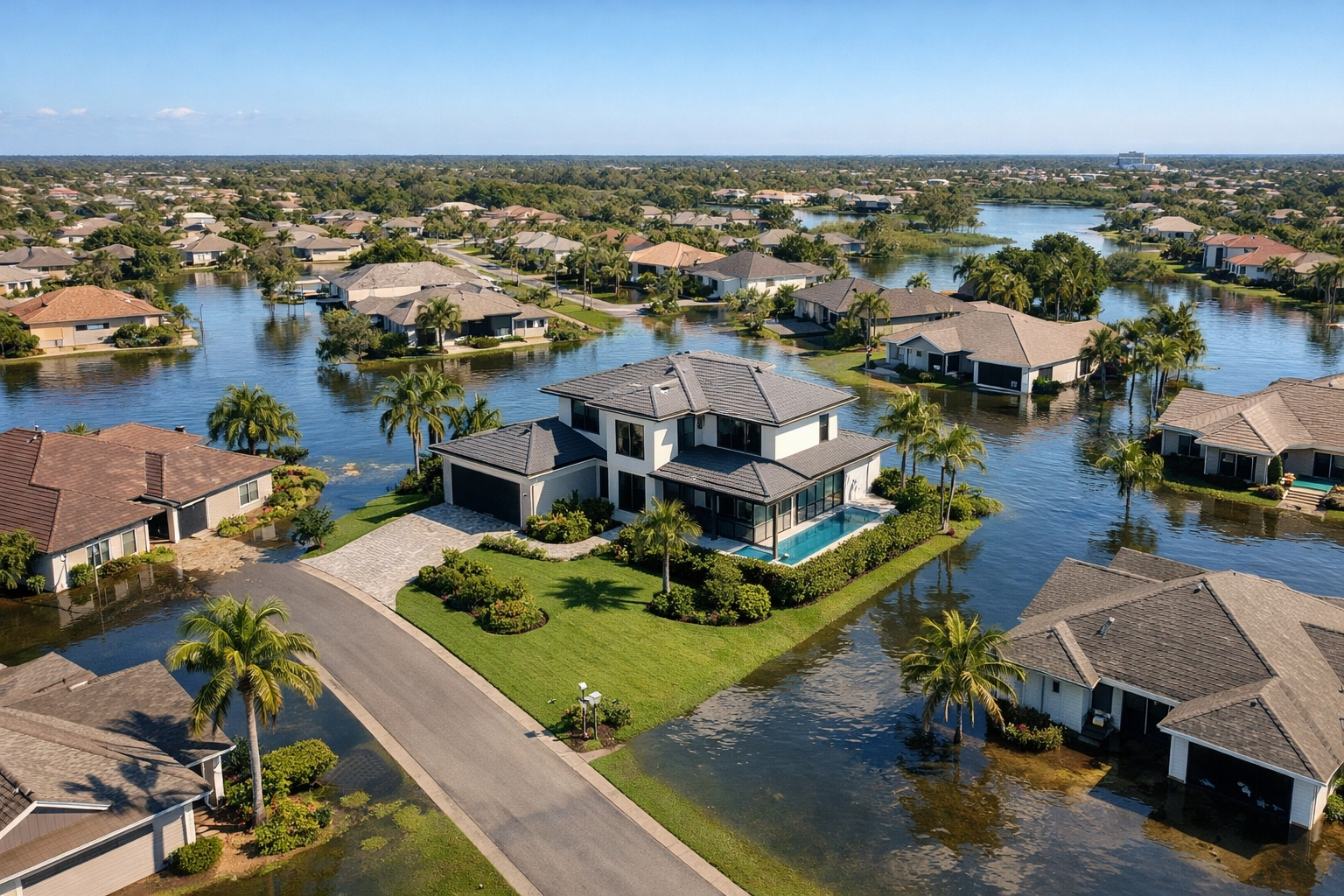
Flooding is one of the most common and costly natural disasters in Florida—and standard homeowners insurance doesn’t cover it. If you live in a flood-prone area, it's essential to consider supplemental protection. Learn everything you need to know in our full guide to Florida flood insurance.

Get a
Florida Home Insurance
Quote




To see how Worth can reduce your risk.
Get a Free Quote


